
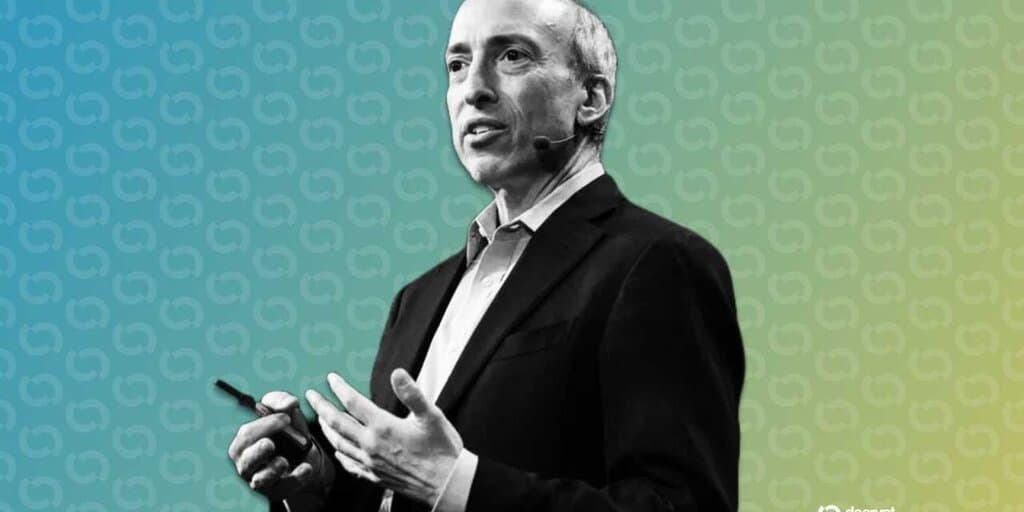
Gensler Supports States in Prediction Market Regulation
"States gain ally in fight over prediction market regulation. Gensler's support sparks debate."
Gary Gensler, Chairman of the Securities and Exchange Commission, has thrown his weight behind states in their battle over the regulation of prediction markets. In a move that is set to have far-reaching implications for the industry, Gensler's support for state-level regulation has sparked a heated debate about the role of federal versus state oversight.
The prediction market industry has been growing rapidly in recent years, with platforms such as PredictIt and Augur allowing users to bet on the outcome of events ranging from election results to sports games. However, the lack of clear regulation has led to confusion and uncertainty, with some states opting to ban the platforms outright while others have taken a more permissive approach.
Gensler's decision to back state-level regulation is seen as a significant victory for states' rights advocates, who argue that individual states are best placed to regulate the industry. "States have always been at the forefront of regulating emerging industries," said one industry expert. "Gensler's support for state-level regulation is a recognition of this reality."
The implications of Gensler's decision are likely to be significant. For one, it could lead to a patchwork of different regulatory regimes across the country, with some states opting for stricter oversight while others take a more lax approach. This could create confusion and uncertainty for platforms operating across multiple states, and may even lead to some platforms opting to cease operations in certain states altogether.
On the other hand, Gensler's decision could also be seen as a boost for innovation and competition in the industry. By allowing states to take the lead on regulation, it may encourage more states to experiment with different approaches, potentially leading to more effective and efficient regulatory regimes. "This is a chance for states to show that they can regulate the industry in a way that is both effective and supportive of innovation," said another industry expert.
The context for Gensler's decision is also worth considering. The prediction market industry has been the subject of increasing scrutiny in recent years, with some critics arguing that it poses significant risks to consumers and the broader financial system. In 2020, the Commodity Futures Trading Commission (CFTC) issued a warning to PredictIt, one of the largest prediction market platforms, over concerns that it was operating without proper registration.
Gensler's decision to back state-level regulation may be seen as an attempt to address these concerns while also avoiding the need for federal-level regulation. By delegating regulatory authority to the states, Gensler may be hoping to create a more nuanced and effective regulatory framework that is better equipped to address the unique challenges posed by the prediction market industry.
However, not everyone is convinced that Gensler's decision is the right one. Some critics argue that state-level regulation is insufficient to address the risks posed by the industry, and that federal-level oversight is necessary to ensure consistency and protection for consumers. "This is a federal issue that requires a federal solution," said one critic. "Gensler's decision to back state-level regulation is a cop-out."
As the debate over prediction market regulation continues to unfold, one thing is clear: Gensler's decision to support state-level regulation has significant implications for the industry and its future development. Whether this decision ultimately proves to be a boost for innovation and competition, or a recipe for confusion and uncertainty, remains to be seen.

