Ferveret, a startup founded by Reza Azizian and Matteo Bucci, is in Massachusetts.
"Data centers face enormous energy demands, but a new cooling system could change that."
The rise of artificial intelligence is driving an enormous expansion of data centers, with these facilities projected to account for anywhere from 9 to 17 percent of total electricity usage in the U.S. by the end of the decade. Today, around a third of data center electricity is devoted to cooling the chips that run AI models. This is the process that Ferveret is working to make more efficient.
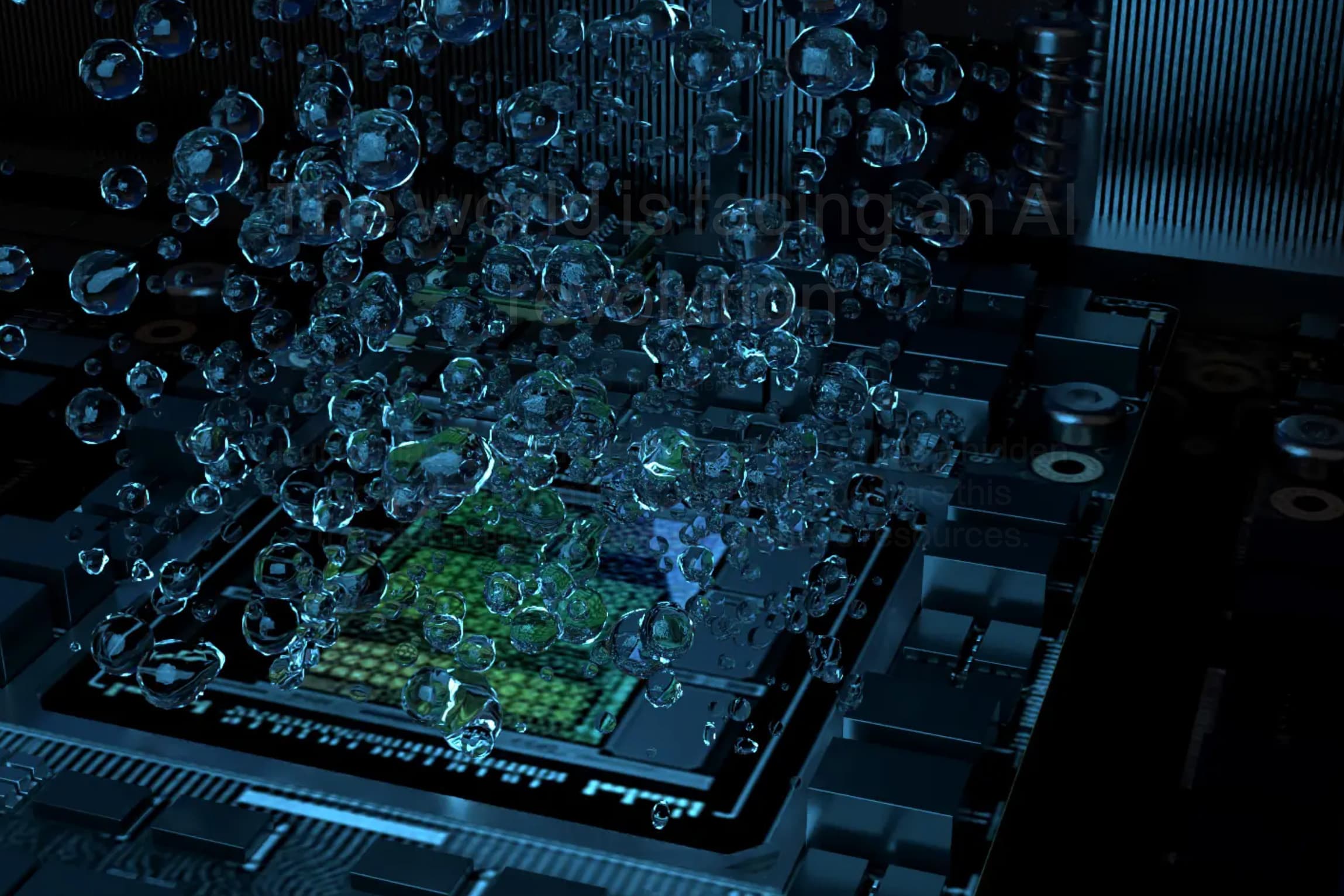
The company's cooling system submerges computer servers in a specialized liquid that absorbs heat much more efficiently than air from a fan. What makes the solution different from other liquid cooling systems are the bubbles: Ferveret's Adaptive Phase Cooling (APC) solution produces much smaller bubbles at the surface of the server, which detach more frequently, accelerating the heat transfer process.
Ferveret is already testing its solutions with companies including CleanSpark, the data center developer and operator, as well as FuriosaAI, an AI accelerator company, and Switch, one of the largest data center operators in the U.S. In a recent study in collaboration with the Samueli Computer Science Department at the University of California at Los Angeles, Ferveret found its APC solution led to a 15 percent improvement in computational power efficiency compared to state-of-the-art liquid cooling solutions.
By combining those savings with Ferveret's power control system to optimize operating conditions, the company says it allows data centers to get 35 percent more tokens — small pieces of text or data — from their AI models with the same amount of power. This is a significant improvement, as data centers are under increasing pressure to reduce their energy consumption while also increasing their computational power.
Azizian was a postdoc at MIT in 2013 when he met Bucci, who was then a research scientist. They worked on heat transfer in nuclear reactors before Azizian went into industry, where he shifted his focus to cooling chips. Azizian first worked on Microsoft's HoloLens augmented reality headset and then joined Nvidia, which produces the graphical processing units companies use to train and run the latest AI models.
Meanwhile, Bucci continued conducting research at MIT, becoming an assistant professor in 2016. Azizian walked into his first data center in 2017, where he was struck by the massive, noisy fans that filled the building as they cooled. He thought that this was not an efficient way of doing things, but since it wasn't hurting the performance, no one cared that the cooling technology was 50 years old.
Azizian began talking with Bucci about applying their knowledge around optimizing heat transfer in nuclear reactors to data centers. Scientists have spent decades finding better ways to move heat in nuclear reactors. Heat transfer determines how much energy you can extract from the reactor core, which translates directly to revenue.
The founders of Ferveret saw an opportunity to apply this knowledge to data centers, which face similar challenges in terms of heat transfer. By using a liquid cooling system, Ferveret's APC solution is able to absorb heat much more efficiently than air from a fan. This is particularly important for data centers, which are under increasing pressure to reduce their energy consumption while also increasing their computational power.
Ferveret's solution has the potential to make a significant impact on the data center industry, which is projected to continue growing in the coming years. As more companies move their operations online, the demand for data center space is increasing, and with it, the demand for more efficient cooling systems. Ferveret's APC solution is well-positioned to meet this demand, and the company is already seeing interest from major data center operators.
In addition to its potential to reduce energy consumption, Ferveret's solution also has the potential to increase computational power. By allowing data centers to get more tokens from their AI models with the same amount of power, Ferveret's solution could enable companies to train more complex AI models, which could lead to breakthroughs in fields such as healthcare and finance.
Overall, Ferveret's APC solution has the potential to make a significant impact on the data center industry, and the company is well-positioned to capitalize on the growing demand for more efficient cooling systems. With its innovative approach to heat transfer and its potential to increase computational power, Ferveret is a company to watch in the coming years.
The company's goal is to make data centers as sustainable as possible and help them use every single watt of power to generate tokens, which are the most useful outputs. Ferveret's system enables the operation of more powerful chips, it helps data centers waste a lot less energy, and it accomplishes all that with zero water consumption. This is a significant advantage, as water consumption is a major concern for data centers, particularly in areas where water is scarce.
In conclusion, Ferveret's APC solution has the potential to revolutionize the data center industry by providing a more efficient and sustainable cooling system. With its innovative approach to heat transfer and its potential to increase computational power, Ferveret is a company that is well-positioned to capitalize on the growing demand for more efficient cooling systems. As the data center industry continues to grow and evolve, companies like Ferveret are likely to play an increasingly important role in shaping its future.